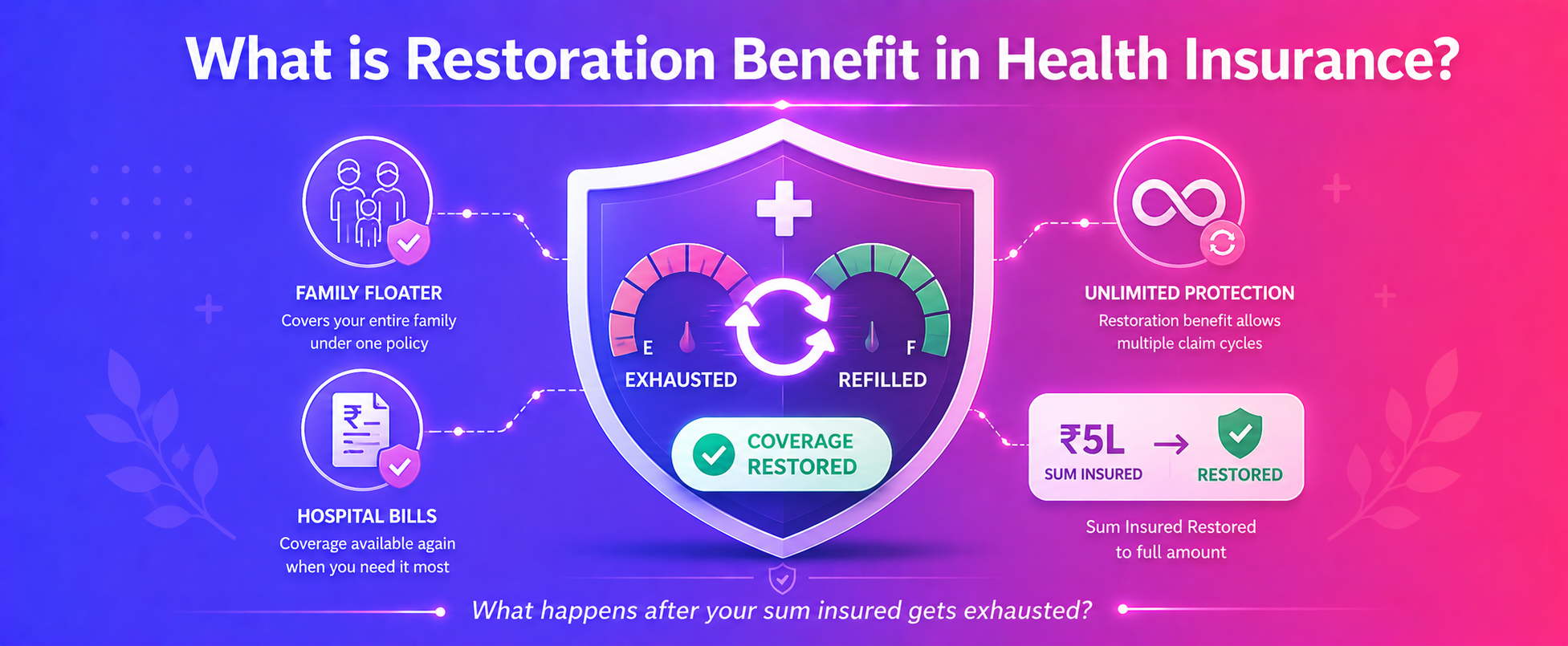
Healthcare costs in India keep rising sharply. Many people often wonder if their health insurance covers them enough. They worry about big medical problems. Just one hospital stay can use up your sum insured fast. Even a few claims might use it all in one policy year.
This common worry shows why the restoration benefit in health insurance is important. This feature works like a key financial backup. It returns your sum insured once you have used it all. This usually makes sure you still have cover for new claims in the same policy year.
This guide will explain what the restoration benefit is and how it works. We will also discuss its different types and main benefits. Understanding this feature helps policyholders choose better for their health plan.
What is the restoration benefit in health insurance?
Understanding the restoration benefit in health insurance meaning is important. This feature automatically brings back your first sum insured. It usually happens after you use all your policy money in one year.
The restoration benefit ensures you still have protection for new, different medical claims. It works during the same policy period while your policy is active.
To define restoration benefit in mediclaim, consider this: your insurance money refills. This restoration benefit in health insurance means your money protection does not stop. This stays true even after one big claim.
People also call this the refill benefit or sum insured restoration. Insurance companies often include it automatically in policies. Sometimes, they offer it as an extra plan for a small cost.
Why is Restoration Benefit Important?
Health care costs are spiraling out of control and a single major illness can wipe out your entire insurance coverage. Any further medical expenses in the same year would have to be paid by the individual, unless restoration was carried out.
Second, the restoration benefit is a financial backup. It gives you peace of mind and reduces exposure to financial strain – it provides continuity of coverage even after large claims.
For floater plans, this feature becomes more important since multiple members will share the same sum insured. The restoration protects one member from having their claim expose the others.
How does the restoration benefit work? (with examples)
How does restoration benefit in health insurance work? This feature acts as a financial safety net. When your sum insured is fully used, the restoration benefit in health insurance means your policy cover gets refilled. This ensures you have money for new, unrelated medical claims. These claims must happen within the same policy year.
When is the restoration benefit triggered? Typically, it starts once claims fully use up your original sum insured. To understand the restoration benefit, consider this: You make a claim. If your sum insured is exhausted, the benefit activates. Your sum insured then refills for new claims.
Most policies restore 100% of your initial sum insured. This extra cover is only for the ongoing policy year. It usually does not carry forward to the next year.
Example of restoration benefit: Imagine you have a Rs. 5 lakh policy. You use Rs. 4 lakh for heart surgery. Later that year, you need Rs. 3 lakh for a different illness. Your restoration benefit would refill your Rs. 5 lakh sum insured. This allows payment for the new Rs. 3 lakh claim.
Scenario 1: a single large claim
Mr. Sharma has a 5 lakh health insurance plan. He faces a serious illness. His hospital bills come to 5 lakh. This single claim uses all his insurance money.
Here, the restoration benefit in health insurance steps in. It refills his plan with another 5 lakh cover. If another family member needs care later in the year, you can use this renewed amount.
- It puts back the sum insured after one claim empties it.
- Provides 5 lakh more cover for new health issues.
- Keeps protecting other family members on a family floater plan.
- Starts automatically, without any extra cost.
Scenario 2: multiple smaller claims
Family floater plans give all family members one total insurance amount. For example, consider a 5 lakh plan. If one family member claims 3 lakh, and another claims 2 lakh, these uses exhaust the initial sum. Then, the restoration benefit in health insurance typically kicks in. It makes the full 5 lakh amount available again for new claims.
- Restores the full insurance money after claims.
- You get continued protection for new health issues.
- It protects different family members within the same year.
Types of restoration benefits
If you have health insurance, understanding your restoration benefit is important. This feature puts money back into your insurance plan. It typically happens in two ways. These are 'complete exhaustion' or 'partial exhaustion' of your insurance money. How this works really changes your coverage for the year.
1. Complete Exhaustion
This is the more common type of restoration. Here, you must use all your original insurance money first. For example, your health plan might be for 5 lakh. A claim must use the full 5 lakh. Only after this does the policy refill the insurance amount. The refilled money is for new claims. These new claims usually need to be for different health issues. Many Indian insurance companies, such as HDFC ERGO and ICICI Lombard, offer this kind of plan.
What is complete exhaustion?
The restoration benefit in health insurance is simple. It starts working after you have used your entire first sum insured. For example, say your policy is for ■10 lakh. You must use all ■10 lakh first. Then, this benefit starts. It helps give you more insurance coverage. This coverage is for
another hospital visit within the same policy year.
- The benefit begins only after your first sum insured is fully used.
- You get new insurance money for different illnesses or accidents.
- Often, it helps the same family member or others on the policy.
- Always look at your policy document for specific rules and limits.
2. Partial Exhaustion
Some plans offer restoration even if you have not used all your insurance money. Imagine your policy is for 5 lakh. If you make a claim for 3 lakh, some plans could still refill the full 5 lakh. This happens even though 2 lakh might still be left. This type is less common. It often gives you more protection. This is especially true if you face many claims in one year.
Here is a simple look at these two types:
- When it starts: With complete exhaustion, you use all your original insurance money. For partial exhaustion, you use only part of it.
- How it helps: Complete exhaustion helps after a big claim uses all your coverage. Partial exhaustion refills even if some insurance money is left.
- How common it is: Complete exhaustion is the most common type from insurers. Partial exhaustion is less common; it is often a special feature.
What is partial exhaustion?
This health insurance feature is known as restoration. It begins even if you use only a part of your total insured sum.
For instance, consider a 5 lakh health insurance plan. If you claim 4 lakh, 1 lakh remains. This benefit makes that 1 lakh available for use. Also, the restored amount becomes ready. This helpful feature ensures coverage for new medical needs.
- Your insurance amount gets refilled after a partial claim.
- It gives you new coverage before your full sum insured is used up.
- Better Financial Protection: This offers more safety for multiple hospital visits.
- Always check your policy for details on how the restoration benefit activates.
3. Same Illness Restoration
Certain policies allow restoration only for unrelated illnesses. This means the restored amount cannot be used for the same illness that caused the initial claim.
4. Unlimited Restoration
Some advanced plans offer unlimited restoration, allowing the sum insured to be reinstated multiple times within a policy year.
Key benefits of a health insurance plan with restoration
A health insurance plan with restoration offers key benefits to policyholders. This feature helps answer the question: "Why should I get restoration benefit?"
- More Financial Protection This benefit gives you more financial safety. It can cover several hospital stays in one policy year. You might not need a very high starting sum insured.
- One family member might have a big claim. This can use up the total sum insured in a family floater plan. But with restoration benefit in health insurance, the other family members keep their coverage. This helps make sure everyone has ongoing protection.
- Getting a higher base sum insured directly can greatly increase your premium. The cost to add the restoration benefit is usually much less. It lets you get more overall coverage at a better price.
- Peace of Mind for Families Knowing your coverage can refill reduces stress during tough times. Policyholders can focus on getting better during a medical emergency. They do not have to worry about using up their health insurance policy limits. These points explain the main "What are the advantages of restoration benefit in health insurance?"
Important conditions and limitations to be aware of
Knowing how your restoration benefit works in health insurance is very important. These points help you understand this feature in most plans:
1. Different Illness Rule: The money you get back typically applies to a new sickness. You cannot use it for the same problem you just claimed for. Does restoration benefit cover the same illness? No, it usually does not.
2. Some plans prevent the same person from using the restored money. They cannot claim again in the same year, even for a different medical event.
3. No Roll Over: Any restored amount you don't use will expire when the policy year ends. Can I carry forward my restored sum insured? No, you cannot move it to the next year.
4. Most basic plans let you use this benefit only once a year. However, certain premium plans offer unlimited restoration. This means you might get the benefit more than one time.
5. What are the limitations of restoration benefit? This feature usually does not apply to your very first claim. You need to make an initial claim before it becomes active.
Who should opt for a plan with restoration benefit?:
The restoration benefit in health insurance can be very helpful for many policyholders.
- Families with a family floater plan often find this useful. If one person uses a lot of the cover, the full sum insured comes back. This helps protect other family members for future health issues.
- You can get more coverage even with a lower base sum. This feature provides extra financial safety without a much higher first payment.
- People seeking a full safety net should consider it. This is good for multiple unexpected health problems in one year. It ensures you have ongoing financial protection.
- Families with a history of critical illnesses also gain. They might need hospital stays more often. This benefit gives strong protection.
Find the best health insurance with restoration benefit on Cover Tiger
It can be tough to find the right health insurance plan. You want one with a strong restoration benefit. Many policies offer this feature. But their specific rules often differ a lot between Indian companies. Knowing these differences helps you get the right financial help.
Cover Tiger makes this choice easy. Our tool helps you quickly compare many health insurance plans. You can easily sort for plans that give good restoration benefits. This way, you see choices from top companies side-by-side.
We give clear, fair advice. This helps you find a plan that truly fits your family and budget. Be ready for any unexpected medical problems. Visit Cover Tiger today to see plans and get full protection for future hospital bills.
Conclusion
The restoration benefit in health insurance offers strong financial cover. It protects against India's rising medical costs. This feature is especially helpful for family floater plans. It can give you real peace of mind. Your sum insured may reset if you need it.
To use these benefits fully, you need to know the rules. Check if restoration happens after you use some or all of your sum insured. Also, understand the rules for restoring cover for the same illness. Consider your family's exact needs. Then, compare plans to find a good restoration benefit.
Frequently Asked Questions
Q: What is 100% restore benefit in health insurance?
The 100% restore benefit means your sum insured is fully replenished if it gets exhausted due to claims within a policy year. This essentially gives you the original coverage amount back for any unrelated illnesses or accidents within the same policy period, which is quite reassuring. Most plans offer this once per policy year, typically for a new, unrelated ailment (do check your specific policy wording).
Q: Can I use the restoration benefit for the same illness more than once in a year?
No, restoration benefit usually doesn't apply to the same illness or condition once the sum insured is exhausted. It's typically for subsequent, unrelated medical emergencies within the same policy year (do check your specific policy wording). Specific terms can vary between insurers and IRDAI-approved plans, so always confirm your plan's exact provisions.
Q: Does the restored amount carry forward to the next policy year if it goes unused?
No, it doesn't carry forward. The restored sum insured is typically specific to your current policy year, meant to replenish your cover if the original amount gets exhausted. It's a fresh start each year, so any unused restored amount from the previous year will simply lapse (this is standard for health plans).
Q: Does the restoration benefit apply to the very first claim of the policy period?
No, the restoration benefit won't apply to your very first claim in a policy year. It typically activates only once your original sum insured has been partially or fully used by a prior claim. Your initial medical expenses are always covered by the primary sum insured you start with (check your policy terms). It's essentially for subsequent claims within that same policy period.
Q: How many times can the restoration benefit be activated in a single policy year?
In most plans, the restoration benefit usually activates just once per policy year. This resets your sum insured if it's exhausted by a claim (often for unrelated conditions). Some premium plans might offer more, but it's crucial to check your specific policy wording (especially for the limits on each family member).
Q: Is the restoration benefit automatically included in all health insurance plans?
The restoration benefit isn't automatically part of every health insurance plan here in India. It's often an inbuilt feature in more full policies, or something you can opt for as an add-on (this can vary by insurer). You really must check your policy document, as your chosen plan might not include it.
Q: Can the restoration benefit be used for pre-existing diseases?
Restoration benefit can definitely cover pre-existing diseases, but only once their specific waiting periods (as per your policy document) are fully completed. You'll find it typically applies to different illnesses within the same policy year, not the one that originally exhausted your sum insured. It's for subsequent, new medical conditions, including other eligible pre-existing ones.
Q: Will adding a restoration benefit increase my insurance premium?
Adding a restoration benefit typically increases your health insurance premium. This feature restores your sum insured (often once) after a claim within the same policy year. It's a minor hike, but many policyholders consider it a valuable addition for extended coverage (depending on the insurer's terms), especially given rising medical costs.